Flanders is not lonelier because people have gotten worse at making friends; it's lonelier because the everyday places that used to make friendship automatic have quietly disappeared. Nearly six in ten young adults in Flanders now feel lonely at least sometimes. Coliving does not fix this by accident — it rebuilds the proximity, rhythm, and shared ritual that belonging has always depended on, right here in Antwerp.
In this article
There is a particular quiet that settles into a new apartment around eight in the evening, once the boxes are unpacked and the street outside has become background noise instead of a foreign sound. It is not sadness, exactly. It is the sound of feeling at home in Antwerp not yet having happened — a life with all its furniture and none of its rhythm.
Belonging was never just a feeling. It was infrastructure: the neighbor who waves, the café where someone remembers your order, the housemate who is already up when you are. Take that infrastructure away — as moving city, moving countries, or simply moving into your first solo apartment tends to do — and loneliness stops being a mood and starts being a design flaw.
Antwerp is not immune to this. If anything, the numbers coming out of Flanders over the past two years suggest the opposite.

Loneliness in Flanders is no longer an old-age issue: a 2024 survey by KU Leuven, Thomas More, and VUB found that 57% of 18-to-24-year-olds feel lonely sometimes or often — more than any other age group. More than a third of all Flemish adults report the same.
This isn't a Belgian anomaly. The World Health Organization now treats loneliness as a global health priority in its own right — something like the missing pillar of health, alongside diet and exercise — estimating that roughly one in six people worldwide experience it, most acutely among adolescents and young adults. In the United States, the Surgeon General's 2023 advisory on social connection found that chronic isolation carries health risks on par with other major public-health concerns, and specifically called for cities to invest in the shared, everyday spaces where casual social contact can happen.
The KU Leuven researchers found something worth sitting with: people who exchange a simple "goeiendag" with their neighbors more than once a week are far less likely to feel chronically lonely than those who never do. Loneliness, in other words, is not cured primarily by deep friendship. It is buffered by proximity; by the accumulation of small, unremarkable contact.
Antwerp's housing conversation tends to be about square meters and euros per month. That conversation isn't wrong, exactly — it's just answering the wrong question. A room can be affordable, well-located, and freshly renovated, and still fail to produce the thing a person actually moved to the city for: a life that includes other people in it.
Call it the belonging shortage. It doesn't show up in a rental listing, but it shows up in everything else: in how quickly someone starts eating dinner alone out of habit rather than choice, in how many evenings pass without a single unplanned conversation. Sociologists have started calling the broader pattern the loneliness economy — an entire generation quietly willing to pay, structurally, for what used to come free with a neighborhood.
HOC has written before about what Gen Z is teaching everyone else about the future of home: that community isn't a bonus feature bolted onto housing, but the actual product being asked for. Coliving, at its best, is a direct answer to the belonging shortage rather than the housing shortage. It doesn't just put a roof over someone's head faster; it puts other people under that same roof, on purpose.

A building does not become a home by being finished. It becomes a home by acquiring rhythm — the small, repeated things that give a week its shape and its people their familiarity with each other.
We've written before about rituals as the invisible architecture of belonging: the welcome dinner for a new housemate, the Sunday coffee someone always makes too much of, the goodbye tradition before someone moves out. None of these appear on a floor plan. All of them are, in practice, what a person is actually renting when they choose to live with others rather than alone.
This is the quiet argument for coliving over a shared flat found on a listing site. It isn't just about splitting a lease with strangers; it's about someone — a house team, a community host, a set of habits already in motion — doing the work of turning proximity into rhythm before you arrive. You don't have to build the rituals yourself. You move into ones that already exist, and then you start adding your own.
Belonging in Antwerp tends to have a postcode: the Seefhoek's converted warehouses, Antwerp Zuid's gallery-lined streets, or the walkable stretch near Antwerp Central Station. What makes these neighborhoods feel like home isn't the architecture alone — it's a coliving house inside them that turns a street into a shortcut to people you already know.
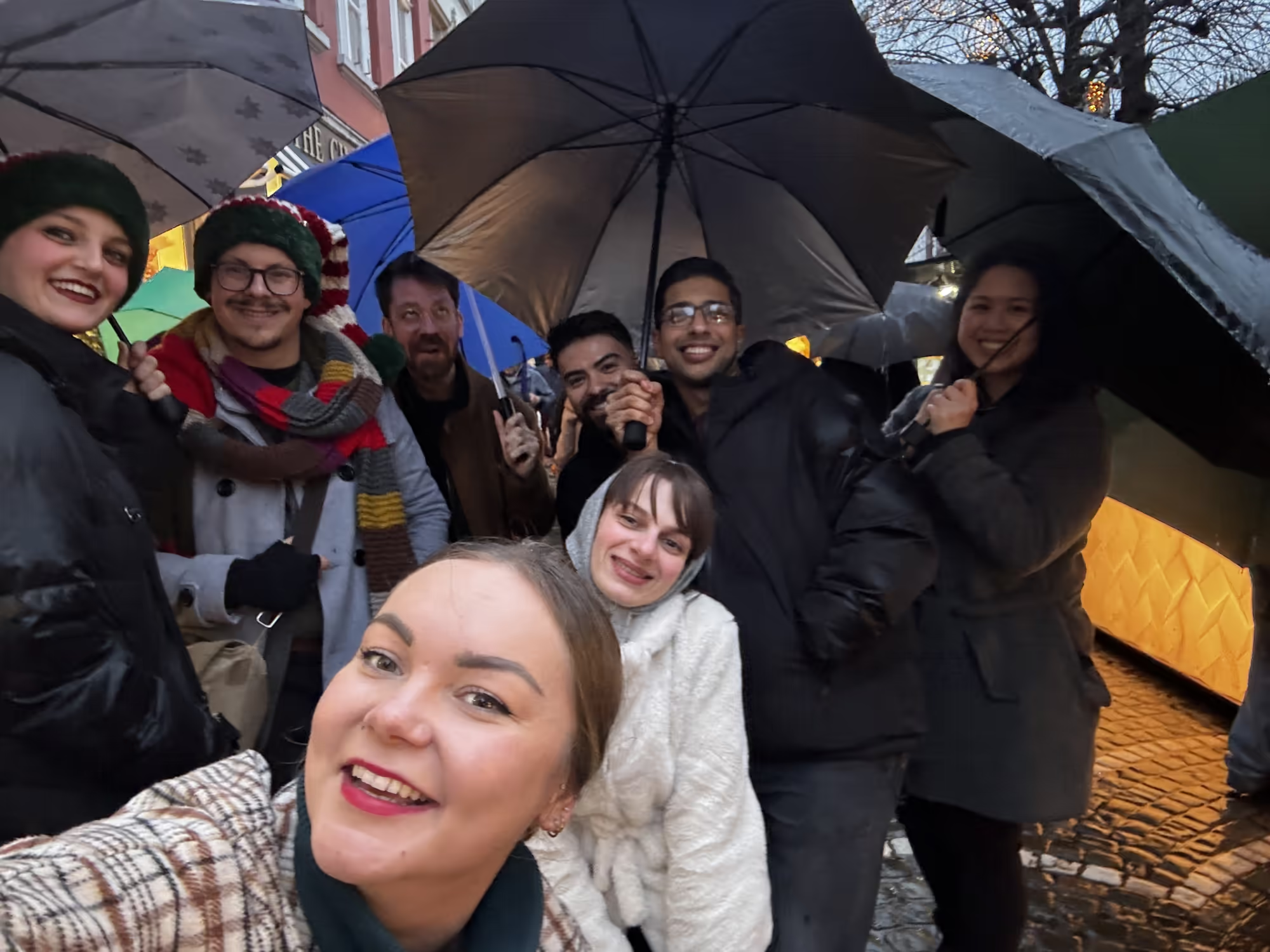
Ask someone who has actually lived it, and the feeling gets more specific. Patrick Sevenans described arriving at Seef Yard to a garden with a small swimming pond guarded by two stone lions, and neighbors who became less like housemates and more like a found family within weeks. Elsewhere in the city, one resident wrote about becoming pleasantly hooked on Antwerp itself — the coffee at Koffie Dealers, an evening at The Barn — treating the city as a daily adventure rather than a place to merely reside.
Katrien Bartholomeeusen's story follows a shape HOC hears often. She came back to Antwerp after a stretch of working abroad, looking for what she assumed would be a temporary solution while she found her footing in her own hometown. It didn't stay temporary. As HOC put it in response to her review, what started as a stopgap turned into somewhere she genuinely enjoys calling home — which is, in miniature, the entire argument of this article.
Coliving differs from a shared rental in the way it is built, not just in what it costs. Someone is responsible, full-time, for the community side of the house — organizing events, hosting newcomers, maintaining the rhythm — which is structural, not incidental, and part of why the category has grown to more than 110,000 beds across Europe.
The industry's own framing tends to lean on relocation logistics: built-in community that helps you settle in faster, meet people, skip the stress of starting from zero. That's true as far as it goes, if a little bloodless. The residents living it tend to describe something warmer.
Styn Coumans, a resident, put it more plainly: "HOC doesn't just provide a place to stay; it offers a community where you can rediscover yourself and build friendships that last a lifetime." That is, in one sentence, the case for community as infrastructure rather than amenity — the part no floor plan can promise on its own.
Coliving is not a cure in the medical sense, and treating it as one oversells what any housing model can do. It's closer to what public-health researchers call a community-level intervention: it doesn't eliminate loneliness, but it removes several of the structural conditions — isolation, unfamiliarity, a lack of casual contact — that make loneliness worse.
Even the word "epidemic" is contested. Some researchers argue the data doesn't quite support the label, even as they agree loneliness remains a serious issue with a real health toll. The Surgeon General's advisory named strengthening local social infrastructure as one of six national priorities regardless of what the condition gets called, and the WHO frames connection as something like a missing pillar of health — not the whole building, but load-bearing all the same.
What coliving offers, honestly, is not a guarantee. It's a structure that makes the ordinary work of belonging — the good mornings, the shared dinners, the people who notice when you're around — considerably easier to do by accident. For some of the loneliest years of a person's life, that turns out to matter more than it sounds like it should.

Loneliness in Flanders is real, and it is youngest among the young. Belonging was always built from small, repeated, unglamorous contact rather than grand gestures. Coliving, done properly, is one of the few housing models actually designed around that fact rather than despite it.
None of this requires a leap of faith to test for yourself. If the last few paragraphs sounded less like marketing copy and more like your actual week, it might be worth finding your people at HOC before you find yourself eating another dinner alone out of habit. Or, more simply: book a room, and see what a building with rhythm already built in feels like from the inside.
A home was never just an address. It was always, quietly, the people who made the address worth returning to.
Is the "loneliness epidemic" a real, measurable trend, or is that just a dramatic label?
The scale of the claim is genuinely debated: some researchers argue the word "epidemic" overstates what the data shows, while others, including the WHO and the US Surgeon General, treat it as a serious and worsening public-health issue regardless of the label. What isn't in dispute is the Belgian data: a 2024 survey found 57% of 18-to-24-year-olds in Flanders feel lonely sometimes or often, more than any older age group.
What actually makes coliving different from just renting a room in a shared house?
In a typical shared house, community is whatever the housemates happen to create among themselves. In coliving, someone is responsible for that side of things full-time — organizing events, welcoming new residents, keeping shared spaces and rituals running — which is part of why the model has scaled to more than 110,000 beds across Europe. It's the difference between community as a hobby and community as a job.
Does coliving genuinely help with loneliness, or is that just marketing language?
The mechanism is plausible and reasonably well supported: a 2024 KU Leuven, Thomas More and VUB survey found that people with frequent casual contact with neighbors — something coliving is built around — report meaningfully lower rates of chronic loneliness. It isn't a guarantee for any individual, but as community-level interventions go, it addresses the right variable.
Is coliving only for people who are new to a city, like expats or students?
No — plenty of residents, like Katrien Bartholomeeusen, are locals returning to their own city after time away and looking for something less isolating than living alone. Coliving tends to suit anyone whose life is in a transitional or exploratory phase, whether that transition is geographic, professional, or simply personal.
Next article
I’m happily hooked on Antwerp — the city where I was born and which still manages to surprise me every day. From King Square Mansion on Rotterdamstraat, where I live as part of the warm community at HOC Coliving, I cycle into the city almost every day. For a coffee, to do some shopping at The Barn, but above all to soak up Antwerp: the people, the hustle and bustle, the architecture and the countless stories that seem to come to life here in every street.
Continue reading